Now Accepting New Clients in Tucson, Marana, Oro Valley, Sierra Vista, Vail, Phoenix and anywhere in Arizona 520-525-5554

Why Anxiety Can Feel So Irrational
Part 1: Understanding Your Anxiety
4 min read
Understanding Your Anxiety
Anxiety can be incredibly frustrating.
Part of you knows there is nothing to worry about, yet the anxiety continues to show up.
You tell yourself:
"I'm fine."
"Nothing bad is happening."
"There's no reason to be anxious."
And yet your heart races, your stomach tightens, and your mind begins searching for answers.
So what's happening?
Meet Your Amygdala
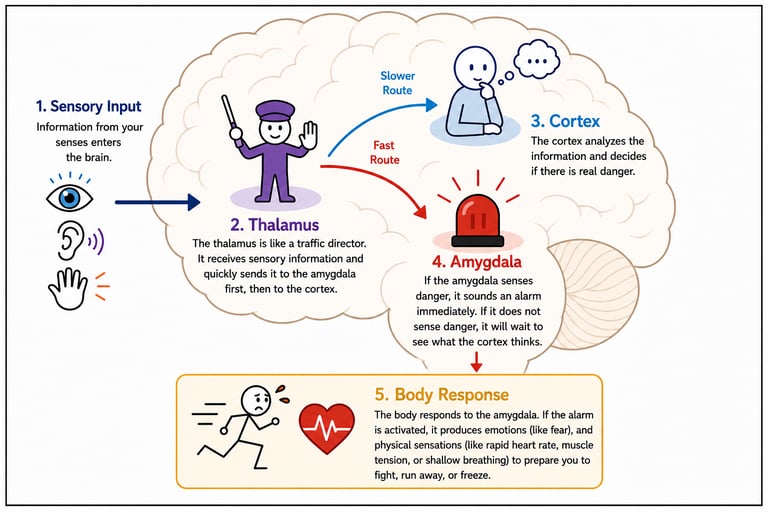
Deep within the brain is a small structure called the amygdala.
One of the amygdala's primary jobs is to identify potential threats and initiate emotions such as fear, anxiety, panic, and worry when danger is detected.
This is actually a good thing.
If we didn't experience fear or anxiety, we wouldn't recognize danger or take steps to protect ourselves.
The amygdala also activates the body's defense response, often referred to as fight, flight, or freeze.
When this happens, measurable changes in the body occur almost instantly:
Your pupils dilate.
Your heart rate increases.
Adrenaline and cortisol are released.
Digestion slows.
Muscles tighten.
Blood flow is redirected toward the extremities needed for fighting or escaping.
These changes prepare your body to respond to danger.
Without them, we might recognize a threat but lack the physical readiness to protect ourselves.
We need the amygdala.
We need fear.
And we need the body's defense response.
They keep us alive.
The problem occurs when the amygdala mistakenly identifies something as dangerous when it isn't.
That's when anxiety can start to feel crazy-making.
How the Amygdala Gets Its Information
The amygdala receives information from two primary sources:
Your senses
Your thoughts
Let's start with the senses.
Information about everything you see, hear, smell, taste, or feel is first sent to a part of the brain called the thalamus.
The thalamus acts like the brain’s traffic director, funneling incoming information to different parts of the brain.
Two important destinations are:
The amygdala (the reactive part of the brain)
The cortex (the thinking, reasoning part of the brain)
The amygdala receives the information first.
This is by design.
Your brain would rather react quickly to a possible threat than spend valuable time analyzing whether the threat is real.
If the amygdala interprets the incoming information as dangerous, it immediately sounds the alarm and activates the corresponding emotional and physical responses.
Only afterward does the cortex have an opportunity to analyze what has happened and determine whether the threat was actually real.
This is why you jump and quickly move away at the sight of a long, winding object lying in the grass before realizing moments later that it’s not a snake, it’s actually a garden hose.
Your amygdala reacted first.
Your cortex caught up later.
Once your thinking brain recognizes that you're safe, a calming message is sent back to your nervous system. However, your body still experienced a surge of physical sensations that take time to settle. So, even though you now know there was no real danger, your brain may remember the experience as something to be cautious about. The next time you’re in the yard, you may find yourself automatically scanning the ground more carefully or notice your body becoming tense or on edge. In an effort to protect you from what it now believes could be danger, your brain may even begin nudging you toward avoidance of the yard altogether—even if you can't quite explain why.
When Thoughts Become the Threat
Sometimes the amygdala reacts to sensory information.
Other times, it reacts to thoughts.
If the amygdala does not perceive immediate danger from your environment, it continues monitoring information coming from the cortex.
When your thoughts focus on worst-case scenarios, uncertainty, danger, or potential problems, the amygdala may interpret those thoughts as evidence that a threat exists.
When that happens, it activates the same emotional and physical alarm system.
In other words, your body can respond to a thought as if it were a real threat.
Imagine you’re home alone at night and hear a scratching sound at the window, but your amygdala does not initially interpret the sound as dangerous so you remain calm. As you continue listening, your mind begins imagining an intruder trying to get inside. Although nothing has changed in your environment, something has changed in your thinking. Your amygdala responds to those thoughts as evidence that danger may be present and sounds the alarm by initiating fear and physical responses, preparing your body to protect you.
The Good News
The good news is that anxiety is not a sign that something is wrong with you.
More often, it is a sign that your brain is doing exactly what it was designed to do—protect you.
The challenge is that your brain can only respond to the information it receives. Sometimes that information comes from your senses. Other times, it comes from your thoughts. And occasionally, that information is incomplete, outdated, or simply inaccurate.
The more you understand how your brain and nervous system work together, the less mysterious anxiety becomes. Instead of asking, "What's wrong with me?" you can begin asking a much more helpful question:
"What is my brain trying to protect me from?"
That shift in perspective doesn’t make anxiety disappear overnight - but it can replace fear of anxiety with understanding. And understanding is often the first step toward lasting change.
In Part 2 of Why Anxiety Can Feel So Irrational, I'll explain why understanding where your anxiety is coming from—your senses or your thoughts—can help you choose the most effective strategies for calming your brain and nervous system.
Physical location - Tucson, Arizona
Serving all of Arizona via telehealth
If you are in crisis or need immediate support, please utilize the following resources:
Call 911
Call/text 988 - Suicide and Crisis Lifeline
Community Crisis Line - (520) 622-6000
Go immediately to any hospital emergency room
Hope, Inc. Warm Line (non-emergency) - (520) 770-9909
fdfd
You can also find my professional profiles on: