Supporting Clients in Tucson, Marana, Oro Valley, Sierra Vista, Vail, Phoenix and anywhere in Arizona 520-525-5554

Why Anxiety Can Feel So Irrational, Part 2
Calming Strategies
4 min read
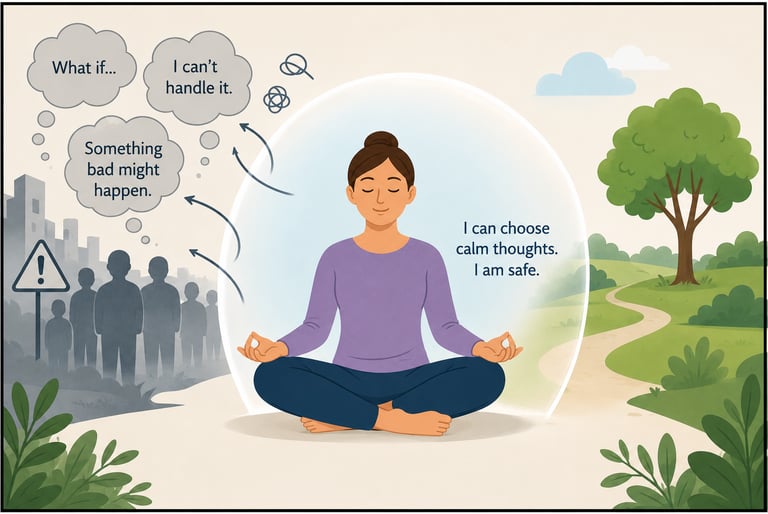
In Part 1 of Why Anxiety Can Feel So Irrational, we explored how the amygdala acts as your brain's alarm system. We also learned that it receives information from two primary sources: your senses and your thoughts.
Understanding where your anxiety is coming from is important because the most effective calming strategy often depends on what triggered the alarm in the first place.
When Your Environment Triggers Anxiety
Do you ever notice anxiety appearing almost instantly?
Maybe it happens at the grocery store.
On an airplane.
Walking into a crowded room.
You may wonder,
"Why am I anxious? Nothing has even happened."
This type of anxiety often begins with the sensory pathway and suggests that your amygdala has associated something in your environment with potential danger. It sounds the alarm and your body responds with a racing heart, tense muscles, and changes in breathing before you can fully identify what triggered the alarm. That’s why trying to reason with yourself in the moment is often ineffective.
Instead, your goal is to help your amygdala learn something new.
What Helps?
1. Practice observing your anxiety instead of immediately trying to make it stop.
2. When it shows up, remind yourself, “Oh, that’s my amygdala.”
3. Remain calm and name (without judgment) what you notice in your body, “My heart is racing.” “My shoulders feel tight.”
4. Become curious, “I wonder what my amygdala believes is dangerous right now?”
5. Look intentionally for evidence of safety around you.
6. Stay with the experience long enough for the sensations in your body to subside.
Every time you remain in a safe situation without escaping or avoiding it, you're giving your amygdala new information.
You're teaching it that the alarm wasn't necessary.
With enough repetition, your amygdala begins updating its expectations
Start Small
If the grocery store creates overwhelming anxiety, don't begin there.
Start with the first step that produces only mild anxiety.
Maybe it’s simply thinking about going to the grocery store.
Driving to the store.
Walking through the entrance.
As your confidence grows, gradually work your way toward the situations that feel more challenging.
When Your Thoughts Trigger Anxiety
For some people, anxiety begins with the environment.
For others, it begins with their thoughts.
Do you find yourself replaying conversations?
Imagining worst-case scenarios?
Worrying about things that haven't happened?
If so, your cortex may be feeding information to your amygdala that sounds like danger.
Remember:
Your amygdala doesn't always distinguish between an actual threat and a vividly imagined one.
If your thoughts repeatedly focus on danger, your amygdala will respond as though danger may truly exist.
What Helps?
Unlike anxiety that begins in the sensory pathway, this type of anxiety responds well to changing your thinking patterns.
Every time we think the same thought, it's like sending another sled down the same snowy hill. Over time, the groove gets deeper, making it easier for our minds to follow that familiar path. The encouraging news is that new pathways can be created—but they require practice.
1. Interrupt the Worry Cycle
You can't stop a thought from appearing—but you can decide what happens next.
When you notice yourself spiraling, intentionally redirect your attention. Give your brain something more constructive to think about.
Ask yourself:
What should I make for dinner tonight?
What can I do this weekend for fun?
What problem can I actually solve right now?
The goal isn't to suppress your thoughts. It's to interrupt the cycle before the worry gains momentum.
2. Replace Worry with More Balanced Thoughts
Once you've interrupted the worry, intentionally introduce thoughts that are more balanced and grounded in reality.
For example:
These are worry thoughts—not facts.
Just because I can imagine something doesn't mean it's likely to happen.
My anxiety has been wrong many times before.
Emotions come and go like waves. This feeling will pass.
Over time, these new thoughts become easier for your brain to access.
3. Check Your Interpretation
Sometimes it isn't the situation itself that activates anxiety—it's the meaning we assign to it.
When anxiety shows up, ask yourself:
"Is it the situation that's making me anxious...or my interpretation of the situation?"
For example, if a car darts in front of you on a busy street, assuming the driver did it on purpose is one possible interpretation—and one that's likely to increase anxiety or anger.
But what if the driver is unfamiliar with the area? Or simply didn't realize the lanes were merging?
The situation hasn't changed.
Your interpretation has.
And sometimes, changing the interpretation changes the emotional response.
Remember...
Every time you interrupt worry, replace it with a more balanced thought, or choose a different interpretation, you're giving your brain new information.
Over time, those repeated experiences become new neural pathways.
Other Ways to Calm Your Amygdala
Although the strategies above are designed to address the specific pathway that triggered your anxiety, there are also practices that help calm your amygdala regardless of where the alarm began.
Controlled breathing
Aerobic exercise.
Meditation
Progressive muscle relaxation
Yoga
Consistent, restorative sleep
Noticing moments of no anxiety - when you feel calm. Your brain needs evidence that safety exists, too.
Each time you practice these skills, you're reinforcing a simple but important message to your brain and nervous system: "I'm safe enough to slow down." Over time, those repeated experiences can help your amygdala become less reactive and more resilient.
The Good News
The encouraging news is that your brain is constantly learning.
Every time you respond to anxiety with curiosity instead of fear...
Every time you stay in a situation long enough to discover you're safe...
Every time you replace a worry thought with a more balanced one…
Every time you practice calming your nervous system…
...you're giving your brain new information.
Little by little, your brain begins expecting safety instead of danger.
That’s how lasting change happens.
Serving all of Arizona via telehealth
If you are in crisis or need immediate support, please utilize the following resources:
Call 911
Call/text 988 - Suicide and Crisis Lifeline
Community Crisis Line - (520) 622-6000
Go immediately to any hospital emergency room
Hope, Inc. Warm Line (non-emergency) - (520) 770-9909
You can also find my professional profiles on: